Contact
Members
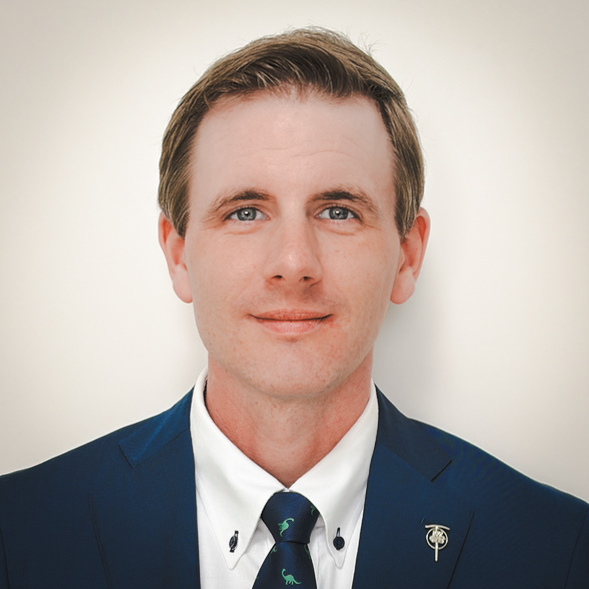
Project Assistant Professor
Benjamin Breeden
- Specialization :
- Vertebrate paleontology; stable isotope geochemistry; early dinosaur evolution; Triassic–Jurassic paleoenvironments; Japanese vertebrate fossil record
- Email :
- bbreedeng.ecc.u-tokyo.ac.jp

Academic Background
Ph.D. in Geology, University of Utah
M.S. in Geological Sciences, The University of Texas at Austin
B.S. in Geology, The University of Maryland, College Park
M.S. in Geological Sciences, The University of Texas at Austin
B.S. in Geology, The University of Maryland, College Park
Biography
I was born and raised in the suburbs of Baltimore, Maryland, on the East Coast of the United States. From an early age, regular visits to museums, parks, zoos, and aquariums in Maryland and Washington, D.C., along with family vacations exploring America’s diverse natural heritage, sparked a lifelong passion for natural history, especially paleontology.
I attended the University of Maryland, College Park, where I majored in geology, conducted geochemical research, and took many biology classes. During that time, I also interned in the Department of Paleobiology at the nearby Smithsonian National Museum of Natural History. These experiences shaped my interdisciplinary approach to research, which integrates data from the fossil record with geochemical evidence to study the co-evolution of living things and their environments throughout Earth history.
In graduate school, my research became increasingly field-driven, and I spent months each year excavating dinosaur and other vertebrate fossils on the Colorado Plateau in the American Southwest. I received my master's degree from The University of Texas at Austin, where I studied early armored dinosaurs. As a Ph.D. student in geology at the University of Utah, I earned a fellowship to conduct fieldwork and study the paleontology and geochemistry of a locality in Yamaguchi, Japan. This work became the subject of my dissertation and ignited my fascination with Japan's fossil record and geologic history.
I moved to Japan in 2022 and completed postdoctoral fellowships at the National Museum of Nature and Science and the University of Tokyo. Alongside my research, I have developed a strong interest in science education through teaching, mentoring, and public outreach. I have served as an English-language consultant for several Japanese museums and publications, and I am currently the English-language editor of Paleontological Research, the journal of the Palaeontological Society of Japan.
I joined the Center for Global Education at the University of Tokyo in 2026, where I teach GLA courses in addition to ALESS/ALESA classes for Junior Division students. Through my teaching, I hope to help students develop as researchers, communicators, and global citizens.
In my spare time, I enjoy playing the drums, studying Japanese, and spending time outdoors.
I attended the University of Maryland, College Park, where I majored in geology, conducted geochemical research, and took many biology classes. During that time, I also interned in the Department of Paleobiology at the nearby Smithsonian National Museum of Natural History. These experiences shaped my interdisciplinary approach to research, which integrates data from the fossil record with geochemical evidence to study the co-evolution of living things and their environments throughout Earth history.
In graduate school, my research became increasingly field-driven, and I spent months each year excavating dinosaur and other vertebrate fossils on the Colorado Plateau in the American Southwest. I received my master's degree from The University of Texas at Austin, where I studied early armored dinosaurs. As a Ph.D. student in geology at the University of Utah, I earned a fellowship to conduct fieldwork and study the paleontology and geochemistry of a locality in Yamaguchi, Japan. This work became the subject of my dissertation and ignited my fascination with Japan's fossil record and geologic history.
I moved to Japan in 2022 and completed postdoctoral fellowships at the National Museum of Nature and Science and the University of Tokyo. Alongside my research, I have developed a strong interest in science education through teaching, mentoring, and public outreach. I have served as an English-language consultant for several Japanese museums and publications, and I am currently the English-language editor of Paleontological Research, the journal of the Palaeontological Society of Japan.
I joined the Center for Global Education at the University of Tokyo in 2026, where I teach GLA courses in addition to ALESS/ALESA classes for Junior Division students. Through my teaching, I hope to help students develop as researchers, communicators, and global citizens.
In my spare time, I enjoy playing the drums, studying Japanese, and spending time outdoors.
Message to Students
In geology, it is often said that “the present is the key to the past. In other words, to interpret the geologic record, we must first understand the processes shaping the Earth today. Yet as human activities reshape the face of the Earth at an unprecedented pace, the past has become equally important for understanding the future.
Our planet's history is written in the rocks and fossils beneath our feet. Together, they preserve the primary evidence of how living things and their environments have responded to episodes of major global change in the ancient past. By learning from the rock and fossil records, we can better understand the global ecological and societal challenges we face today and make more informed decisions about the future.
If this topic interests you, consider joining my GLA course, and let’s explore the fossil record together!
Our planet's history is written in the rocks and fossils beneath our feet. Together, they preserve the primary evidence of how living things and their environments have responded to episodes of major global change in the ancient past. By learning from the rock and fossil records, we can better understand the global ecological and societal challenges we face today and make more informed decisions about the future.
If this topic interests you, consider joining my GLA course, and let’s explore the fossil record together!